
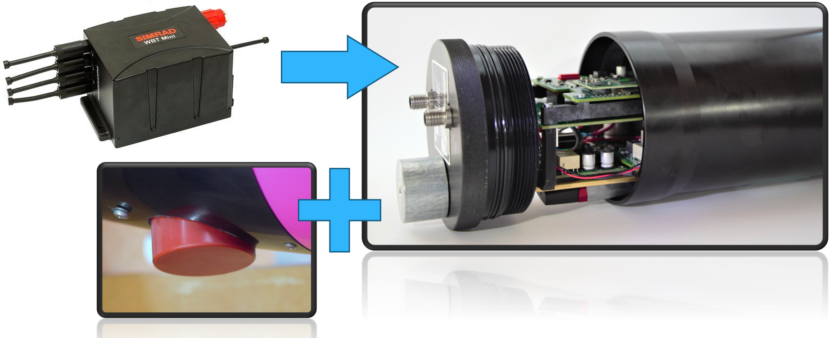
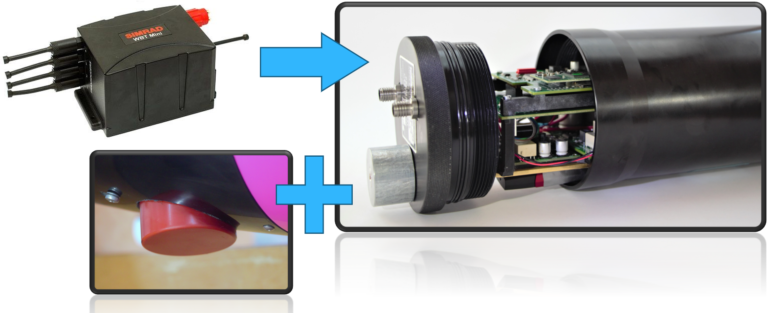
The DeepEcho Module is the first scientific wide-band echosounder — deployable to a depth of 1000 meters — successfully integrated onto an ocean glider. From copepods, krill and fish larvae to micro and macronekton, including fish, scientific echosounders identify and quantify components of the marine ecosystem on a range of scales. Such echosounders also identify gas bubbles in the water column, from seafloor seeps of CO2 or CH4 to leakages from subsea infrastructure.
CSCS redesigned the compact version of the SIMRAD EK80 wideband transceiver (WBT) echosounder to fit within the M1 Seaglider payload bay — reconfiguring the WBT electronics into a cylindrical aluminium pressure housing with a 333 kHz or 200 kHz single-beam transducer, eliminating the need for one of the processing cards.
Seagliders equipped with the DeepEcho Module can efficiently and effectively map the oceans and their ecosystems, profiling in sawtooth-shaped patterns for months at a time while remaining acoustically and electrically quiet — facilitating high-quality acoustic data alongside concurrent environmental profiling (temperature, salinity, dissolved oxygen, chlorophyll-a fluorescence, CDOM, vertical currents).
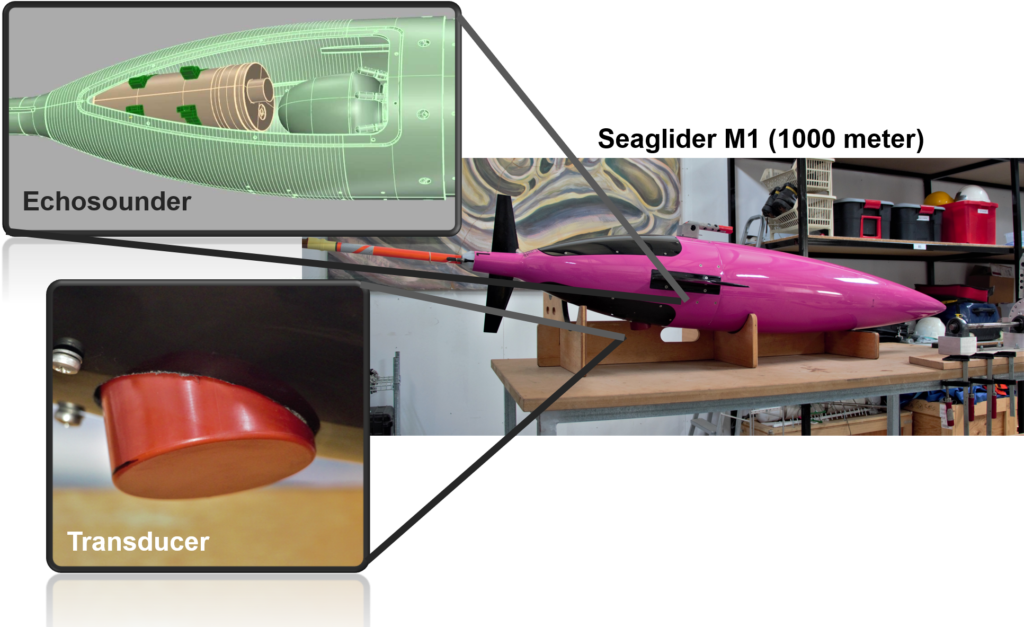
On 5 June 2019, Cyprus Subsea successfully tested the DeepEcho Module on an M1 Seaglider off the coast of Limassol, Cyprus. Experiments for detecting seafloor seeps are being planned, in addition to surveys in the Norwegian Sea to estimate biomass in the mesopelagic zone.